A guide to trading crypto futures
The road exists. It is just longer than they promise.
Fourteen modules on how a trade is built and where the money goes. Every claim here is checked against nine years of history and tens of thousands of trades.
Where this starts
We can hand you a 70% win rate too. Right now.
Every other signal channel advertises something close to seventy percent winning trades. It is not a lie. The number is real, and anyone can produce it in five minutes.
Here is the recipe. Take any entry, set five targets, put the first one very close to entry, and close 20% of the position at each. Any trade that reaches the first target counts as a win.
We ran that scheme across 23 coins. Only instead of a strategy we fed it random entries. A coin flip.
| What we fed it | Win rate | Profit |
|---|---|---|
| Coin flip with a five-target ladder | 70.9% | essentially zero |
The number is not lying. It simply does not mean what you think it means.
There will be no flattering numbers here. There will be a breakdown of how they are manufactured, and of what is left once you strip them away.
What you get
Nine years of calculations on one page
Below is everything we worked out about trading crypto across nine years of history and tens of thousands of simulated trades.
- A strategy with exact parameters: which side to take, where the stop goes, where the target goes, what size
- Four methods sold to you as reliable, with the numbers showing why they are not
- Step-by-step terminal mechanics, with screenshots
- Two platform traps nobody warns you about
Free. No signup, no email. Nothing is hidden behind a subscription.
| Where you are | Start here | Time |
|---|---|---|
| Never traded | Module 01 | 40 min |
| Already trading | Module 04 | 25 min |
| Just want the rules | Modules 07–11 | 12 min |
A fourteen-step course. Every rule condensed onto a single page in the cheat sheet at the end.
What you are about to do
Never traded before? Start here, it takes five minutes. Already trading? Skip to module 04.
You are not buying crypto
Buy bitcoin on an exchange and you own bitcoin. That is an investment.
A futures contract works differently: it is an agreement on the difference in price. You own nothing and store nothing. The price moves, and the difference lands on your account, up or down.
Two consequences follow, neither of which exists when you simply buy a coin. You can make money when price falls — markets fall about as often as they rise. And a trade has an end: the exit is defined in advance, so you are never «holding until things improve».
Three things that decide the outcome
Two of the three are entirely under your control, and that is where the result is actually made.
- Direction. It cannot be known for certain, and that is fine. A working strategy only needs an edge of a few percent over a coin flip.
- Position size. No uncertainty at all: size comes out of a formula. This is what separates a survivable drawdown from a lost account.
- Costs. Fees are known in advance. You can work them out before entering and decline any trade where they eat the whole edge.
Which is why most of this material is about size and costs, not about hunting for the perfect entry.
This is not fortune telling
Professionals do not do it at all.
An insurance company has no idea which of its customers will crash a car next month. It still knows, quite precisely, what it will earn over the year. It does not need to call any single case — an edge across many cases is enough.
Trading works the same way. The whole difference between the people who make money and the people who lose it is the size of the edge, and whether they have the discipline to wait for it to show up.
Long, short, leverage and margin
The four words that scare people off the most. Behind them sits simple arithmetic.
Long and short
Long — you make money if the price rises. Short — if it falls.
Shorting feels unnatural at first: how can you sell something you do not have? But we have already established that you are not buying or selling anything. You are only naming the direction you are betting on.
What an open position looks like
Once you enter, the position appears in the table at the bottom of the terminal, showing direction, size, entry price and current profit or loss.

That profit figure changes every second. Remember one thing: while the position is open, the number means nothing. Only where the trade closes matters.
Leverage
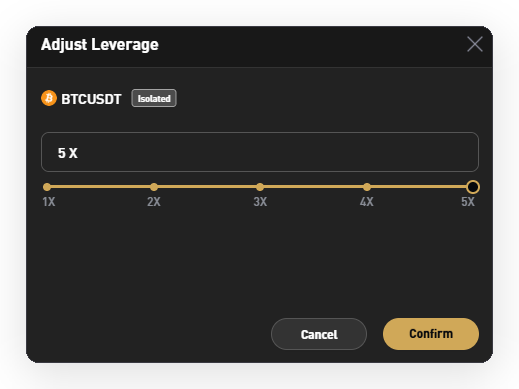
Leverage lets you hold a position larger than the money in your account. At 5x, a $1,000 position requires $200.
This is where the beginner’s biggest misconception lives: «high leverage means high risk».
It is wrong. Leverage determines only how much money gets locked up as collateral. It has no effect whatsoever on how much you lose when the stop is hit.
A $1,000 position with a 5% stop loses $50 — at 5x, at 20x, and with no leverage at all.
Leverage is not the danger. The danger is the position size that leverage lets you inflate.
Margin and its two modes
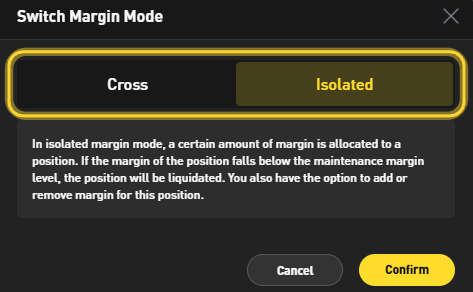
Isolated — separate collateral for each position. If one position dies, the rest of the account is untouched.
Cross — shared collateral across all positions. A drawdown on one drags the others down with it.
A beginner wants Isolated. It caps the damage of any single mistake.
Liquidation
If price moves against you far enough that the collateral no longer covers the position, the exchange closes it for you.

A trader who sets a stop and calculates size never gets liquidated. The stop fires long before it.
Liquidation is not a market risk. It is the consequence of not having set a stop.
Whose money to trade
You have three options, and one of them I do not recommend.
Your own deposit is the most expensive way to learn
Learning on your own money works, and it costs exactly as much as you lose along the way. At the start, you will lose.
Your own capital is better invested; trade someone else’s. These are different activities on different horizons.
Path A: demo first
Free paper trading on TradingView. Real prices, virtual money, the same coins.
The point: you get the mechanics into your hands — which button, how to place a stop, how to size a position — without paying for every typo. Thirty trades is enough.
What a demo will never give you. Feelings.
On a demo you feel none of what shows up in live trading. A three percent drawdown on paper is just a different number on the screen. The same drawdown on real money makes your hand reach for the mouse. Someone who traded a flawless hundred trades on paper will close the first live one early, before the target, because giving back profit suddenly hurts.
Path B: straight to a challenge
You buy an attempt from a prop firm for a fixed fee and trade their money under their rules.
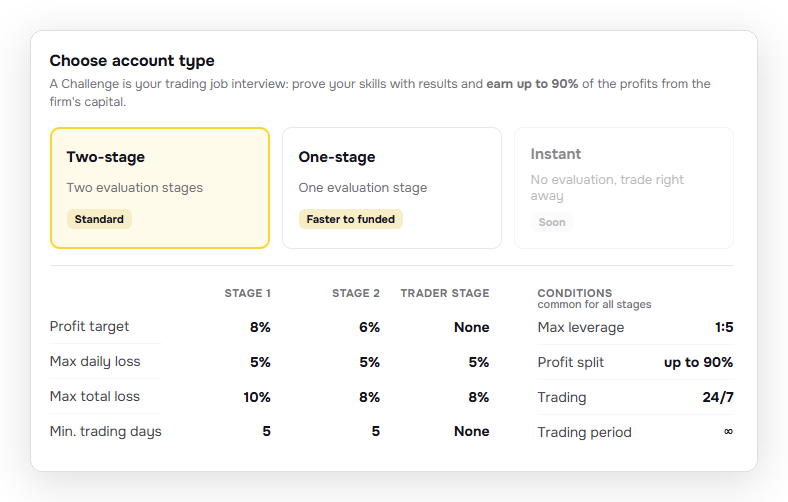
What that means in practice. On a $25,000 account you are trading the firm’s money. Reach the Trader stage and the profit target is removed, with your share at 80% of everything earned.
And the second thing, which changes how you prepare entirely: there is no time limit at any stage. You can take as long as you need and trade three times a week.
What you get: your maximum loss equals the fee and is known in advance. The firm carries the account drawdown, not you. On your own account there is no such boundary.
What you give up: hard drawdown limits, both daily and overall. Breach one and the attempt is over, even if you are net profitable.
That matters more than it sounds. A prop account needs not merely a profitable strategy but one with shallow drawdowns. The second requirement is the harder one.
How to choose
Buying a challenge opens access to the signals, the ones covered in module 12. That is a temptation to skip the demo, and an understandable one.
But decide honestly, on one question:
Could I open a trade right now, with a stop and a target, without looking anything up?
Yes — take the challenge. No — thirty demo trades will take a couple of weeks and cost nothing.
The fee will still be there later. A fee spent working out the interface will not come back.
How many trades before you know whether it is working
A hundred. Not ten.
At a 35% win rate, ten losses in a row is an ordinary event. On a sample that small you cannot tell a bad strategy from a normal run of bad luck.
People abandon working systems after seven losses and cling to broken ones after three wins. Both are noise.
Four numbers: direction, entry, stop, target
Every trade has four numbers. If even one is missing, it is not a trade, it is a hope.
Here is a real signal from 24 September 2026. We will go through it line by line.
Side
SHORT bets on a fall, LONG on a rise. That is all.
Trade only longs and you have given up half the opportunities and made yourself a hostage of the market: when it falls, all you can do is wait.
Entry
Entry: $281.61 is the price the position opens at. Market order, immediately.
Not a limit order slightly lower, not «let us wait for a pullback». We tested both: entering at market came out twice as good as the limit version, even though conventional wisdom teaches the opposite.
The reason is simple: a limit order only fills when the market moves against you. You select the worst trades for yourself and miss the best ones, which leave without you.
Stop
Stop: $306.07 (8.69%) is the price at which the trade closes at a loss. It goes in immediately after the position opens, not «I will set it later». Later does not come.
The bracket holds the distance to the stop as a percentage of price. It is the most important number in the whole message, because position size is calculated from it.
Three targets
TP1 (1:1), TP2 (1:2) and TP3 (1:3) are levels measured out from the size of the stop.
1:2 means that if the trade reaches the target, you make twice what you would have lost at the stop. In our example the stop sits $24.46 from entry, so TP2 sits $48.92 below entry.
Of the three levels only TP2 is backed by history. That is the working target. TP1 and TP3 are printed for orientation, so you can see the geometry of the trade as a whole, not so that you close in pieces.
Money
Size: $1,151 is the position size. Margin (5x): $230 is what the exchange locks up on your account. Risk: $100 (1%) is what you lose if the trade closes at the stop.
Hold on to the difference between those three. The position is $1,151, the locked collateral is $230, and what you risk is $100. Most beginners look at the first number and get scared, when only the third one matters.
The decision to enter stays with you
The message carries no explanation of why we are entering now. That is deliberate: somebody else’s confidence in the text changes nothing about the outcome, and it gets in the way of your own thinking.
A signal sees a setup and an entry point. It does not see the broader picture.
A long arrives while the higher trend points down — skip it. There will be more signals; there is only one account. How to read that higher trend is in module 08.
One distinction decides everything here. Skipping by a rule, the same rule for every trade, is part of a strategy. Skipping by mood is improvisation, and afterwards you will not be able to tell what actually worked.
Risk and position size
Position size is not chosen. It is calculated.
You decide exactly one thing: how much money you are willing to lose on this trade. Everything else follows from arithmetic.
The one percent rule
You risk 1% of the account on a single trade. No more, regardless of how good the setup looks.
| Account | Risk per trade | Three trades at once |
|---|---|---|
| $1,000 | $10 | $30 |
| $5,000 | $50 | $150 |
| $10,000 | $100 | $300 |
| $25,000 | $250 | $750 |
| $50,000 | $500 | $1,500 |
At 1% risk, ten losing trades in a row take about 10% of the account. Unpleasant, not fatal. At 5% risk the same run takes half of it.
And the runs will come. At a 35% win rate, ten losses in a row is a normal event that happens regularly.
How size is calculated
On our TAO signal: stop 8.69%, risk $100. So $100 ÷ 0.0869 = $1,151. That is exactly the number printed on the Size line.
The formula shows the essential thing: the wider the stop, the smaller the position. A wide stop does not make a trade riskier. It makes it smaller.
Leverage does not increase risk
Leverage determines only how much money the exchange locks up against the position. It has no effect at all on what you lose at the stop.
A $1,151 position with an 8.69% stop loses $100 — at 5x, at 10x, and with no leverage. Only the collateral changes: $230 at 5x, $115 at 10x.
One check before you enter
Divide the round-trip fee by the distance to the stop.
With an 8.69% stop and a 0.06% fee that is 0.7% of your risk — nothing. With a 0.5% stop it is already 12%, and your edge has to cover that first before it starts making any money at all.
Above 10% and the trade is working for the exchange. Covered in detail in module 09.
How to open a trade
Seven steps from a blank screen to an open position with a stop. The first time takes about ten minutes. By the tenth trade, under a minute.
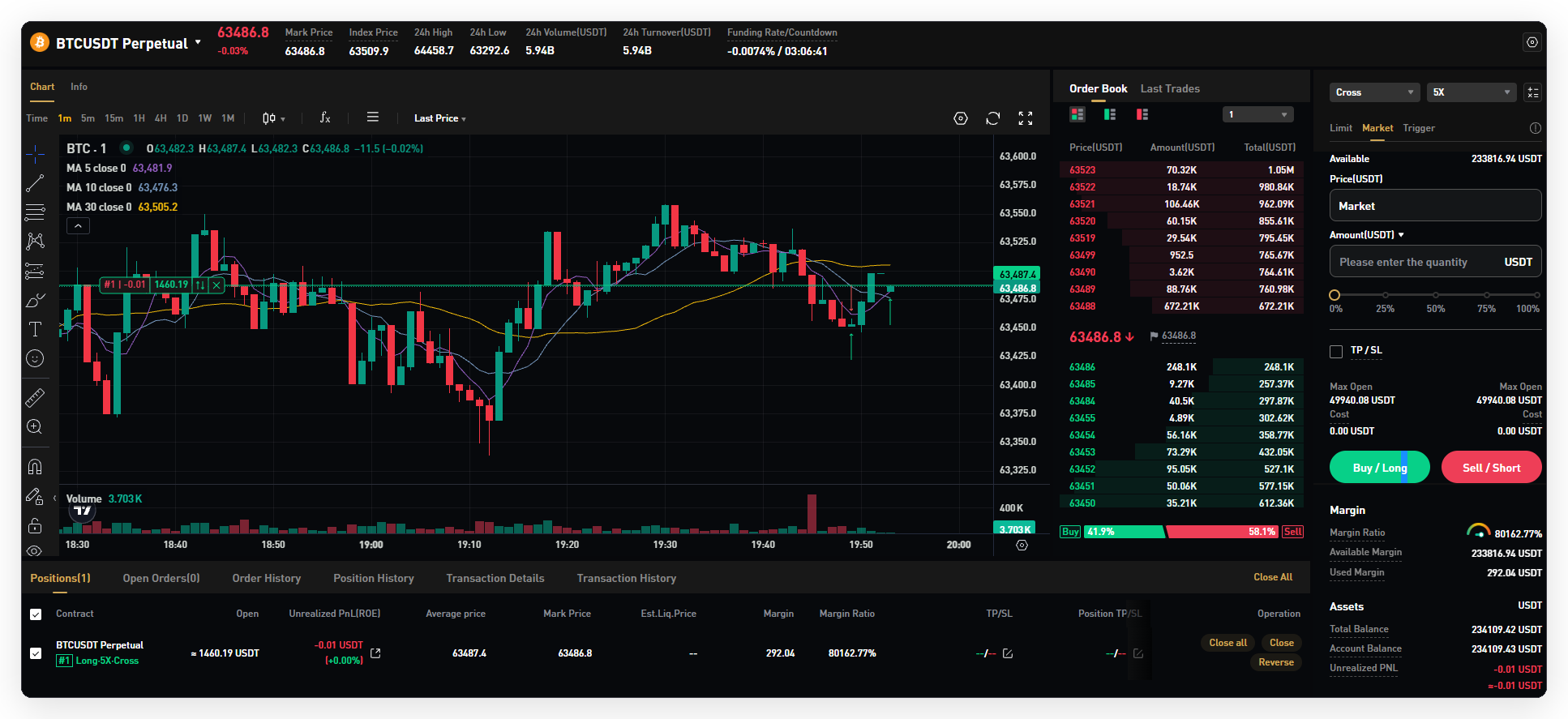
Step 1. Open the terminal
On the Accounts page, press Trade on the account you want.
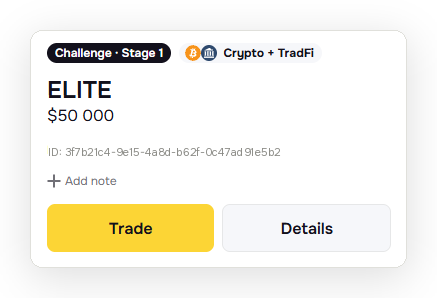
If you have several accounts, check twice that you opened the right one. Trading on the wrong account is an everyday mistake.
Step 2. Pick a coin
BTC/USDT, for example. Each instrument has its own position size cap — if your size will not fit, that is usually why.
Step 3. Set Isolated and leverage
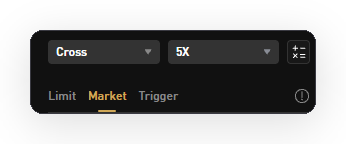
Mode: Isolated. Leverage on this platform runs 1x to 5x; we take 5x.
Repeating module 02, because this is where the hand reaches to set it lower: leverage does not change your loss. It changes only the collateral.
Step 4. Choose the order type
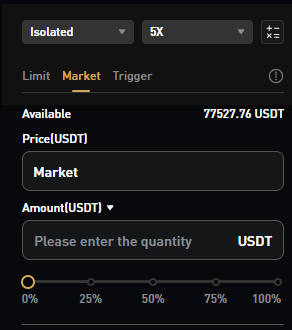
| Tab | What it does |
|---|---|
| Market | Fills immediately at the current price |
| Limit | Waits for your price and may never fill |
| Trigger | Fires when price touches a level you set |
We want Market. Module 04 covered why: a limit order fills only when the market moves against you, and so it selects the worst trades.
Step 5. Enter the size
You already calculated the size in module 05: risk amount divided by the distance to the stop in percent.
The terminal has a slider for 25%, 50%, 75% and 100% of available funds. Do not use it. It offers numbers based on account size, not on your risk. It is the easiest way to open a position three times larger than it should be.
Step 6. Set the stop BEFORE entering
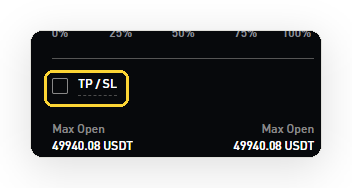
Tick TP/SL and type the prices in. A stop submitted together with the order attaches to the position at once. A stop you intend to set «in a minute» does not exist.
Step 7. Open the position and verify
Press Buy / Long or Sell / Short. The position appears in the Positions tab below. Open it and confirm with your own eyes that your numbers are sitting in the TP/SL column.

That check takes three seconds and saves accounts.
Two traps nobody warns you about
A limit order locks contracts and breaks your stop. If an open limit order to close is sitting on the same position, the stop can trigger and fail to execute, because those contracts are already reserved. Never cover one position with a limit order and a stop at the same time.
Percentages are measured from the current price, not from your entry. Set a stop in percent and the reference point is the market right now. Entering the stop as a price is safer.
How to close early
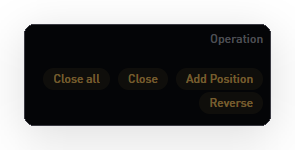
You will rarely need this. A trade should be closed by its stop or its target, not by your patience.
You already know more than most people buying their first challenge
You know how size is calculated. You know why the stop goes in before the entry. You know about the limit order that breaks a stop.
How many trades and how much money in the market
Three trades a day at 1% risk each. And never more than 3% exposed at once.
It sounds like timidity. It is in fact the single most productive rule we tested.
First, how the firm counts you
A challenge has a daily loss limit. Breach it and the attempt is over.
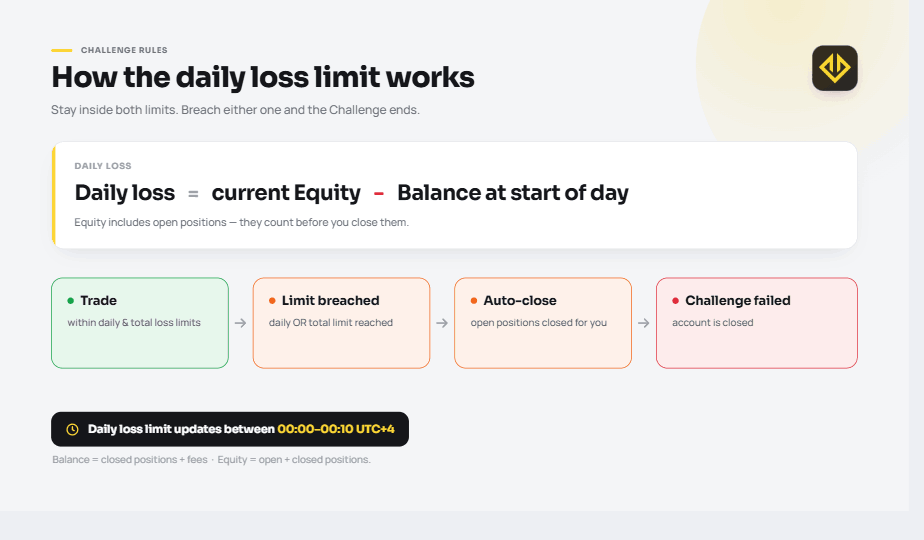
This is the whole point. Equity includes the floating loss on open positions. Not only what you have already realised, but whatever is sitting underwater right now.
The limit is 5% of the starting balance and does not move up as the account grows.
| Challenge | Account | 1% risk | Our 3% ceiling | Their 5% limit |
|---|---|---|---|---|
| Starter | $5,000 | $50 | $150 | $250 |
| Boost | $10,000 | $100 | $300 | $500 |
| Pro | $25,000 | $250 | $750 | $1,250 |
| Elite | $50,000 | $500 | $1,500 | $2,500 |
| Legend | $100,000 | $1,000 | $3,000 | $5,000 |
The gap between our three percent and their five is not caution, it is room for slippage and for price running slightly past the stop.
The main rule: count at the moment of entry
Your three percent covers everything at once: what you have already lost today, plus the sum of the stops on every open position, plus the risk of the trade you are about to open.
Down 2% since morning? For the rest of the day you have one percent, not three.
We measured what that one line of arithmetic is worth. Same strategy, 1% risk, only the accounting changes:
| What we count | Blown on daily limit | Blown on total drawdown | Median result |
|---|---|---|---|
| Open positions only | 18 | 42 | $17,935 |
| Plus what was lost today | 6 | 12 | $28,543 |
Three times fewer blown accounts, more money. Without a single change to the strategy itself.
Why «after a loss I will simply stop entering» does not work
We tested that version separately. The result does not differ from the baseline by a single blown account.
The reason is the formula above. By the time you decide to stop, the positions are already open, and their floating loss keeps dragging equity down without your participation. Banning new entries changes nothing, because it is the old ones that finish you.
The limit has to be applied at the moment you press the button. Later is too late.
More risk does not speed things up
By our calculations, 2% risk across three trades a day drops the chance of passing a stage to 30–47%. You are not going faster; you are switching to a shorter route with a dead end.
Three positions are not three bets
Crypto moves in formation. When bitcoin falls, almost everything else falls with it.
Three 1% longs on different coins are not three independent bets; they are one 3% bet, lightly smeared. Which is exactly why the ceiling sits on the total, not on the number of positions.
How to choose direction
Price higher than two weeks ago: longs only. Lower: shorts only.
That is it. That is the entire direction filter.
It looks primitive next to what gets sold on courses. But of everything we tested across nine years of history, it is the only thing that survived on new data.
The timeframe does not matter; the window length does
Arguments like «should I read the trend on the 4-hour or the daily» are mostly meaningless.
We checked this directly. EMA50 on the 4-hour and EMA200 on the 1-hour are the same 8.3-day window. Switching between them changes nothing, though it feels like changing approach.
Only the window length matters. About fourteen days works. Shorter is noise, longer is lag.
How to check it in ten seconds
No indicators, no drawing. Open the daily chart, look at the close fourteen days ago, compare it with the current price.
Higher: longs only. Lower: shorts only. Near enough flat: skip that coin.
What we tested and discarded
The list is short, but every item on it is sold to somebody as a system.
| What we tested | Result |
|---|---|
| Chart patterns — 5,711 of them across 23 coins, using an academic recognition algorithm | Trading against the patterns is no worse than trading with them. The worst performer is the inverse head and shoulders, the one advertised at «84% reliability» |
| Oscillators and bands | The only valuable thing in them is a trend filter. Which is the same momentum, written down in a more complicated way |
| Strategies from academic papers | A disguised bet on crypto going up: random entries with the same money management returned more |
What to actually expect
A momentum filter does not make you right. It nudges your hit rate a few percent above a coin flip.
That sounds negligible. But edges of exactly that size are what exchanges and funds run on. The difference is that they see the sequence through, while the private trader quits on the seventh loss.
Where to put the stop
Two ATR(14) from entry. Not behind a level, not behind a candle, not «wherever it looks right».
Why ATR and not structure
We tested both on the same trades. Anchoring to ATR came out better.
Not because the formula is magic. A stop answers the question «how noisy is this coin right now». ATR measures exactly that noise. A level on a chart measures your idea of geometry.
A wide stop does not mean more risk
Your risk is always 1% of the account. Stop width changes the position size, not the loss.
| Stop | Position at $100 risk | Loss |
|---|---|---|
| 1% | $10,000 | $100 |
| 3% | $3,333 | $100 |
| 8% | $1,250 | $100 |
The loss is identical. But a wide stop knocks you out rarely and a tight one constantly. In our tests the result improved monotonically with stop width — from 1% through 4% to 20%.
The key check: fees as a share of the stop
Fees on the platform: 0.01% maker, 0.03% taker. Charged on the full position size, leverage included, on the way in and on the way out.

«Just hundredths of a percent» — which is precisely why nobody looks at it. What matters is not the percent of the position, but the share of your risk.
Take the TAO signal from module 04: stop 8.69%, position $1,151, risk $100.
Seven tenths of a percent. Nothing.
Now the same risk with a 0.5% stop, the kind favoured on small timeframes:
Twelve percent of your risk goes to the exchange before the market has moved at all.
The rule: above 10%, the trade is not taken.
Why nobody makes money on five-minute charts
We spent the longest looking for an edge on five- and fifteen-minute charts. It is there — we measured it. But it is worth 2 to 15 times less than the fees.
The reason is mathematical, not psychological: price movement grows with the square root of time, while fees do not depend on the horizon at all. The shorter the trade, the worse the ratio.
Scalping is sold because it looks busy and produces many trades. Many trades means many fees.
Funding
There is a second cost people forget. Funding is a periodic payment between traders, not to the platform. When longs outnumber shorts, longs pay shorts.
On a trade lasting a few hours it is invisible. On a position held for a week it shows up in the balance.
Where to close
The whole position at the 1:2 target. One target, one exit.
This is the most contested module in the whole course, because almost everyone teaches the opposite.
The scheme you will be sold
It goes like this: five targets, close 20% of the position at each, and after the first one move the stop to breakeven. «The trade is now free», they say.
It sounds sensible. And it produces a spectacular win rate, around seventy percent.
We took that scheme and fed it random entries. A coin flip. No strategy at all.
| Entries | Management | «Win rate» | Profit per trade |
|---|---|---|---|
| Random | five-target ladder | 70.9% | +0.003 |
| Random | whole position at 1:2 | 33.9% | +0.008 |
| Our strategy | five-target ladder | 72.1% | +0.018 |
| Our strategy | whole position at 1:2 | 35.0% | +0.043 |
Two conclusions from one table.
A seventy percent win rate comes out of a coin flip. The first target sits very close, about 0.4 of the stop distance. Price reaches it almost every time and the trade is scored as a win. The money is zero.
On a working strategy the ladder cuts profit by more than half. From +0.043 to +0.018 per trade.
Why it works out that way
Closing in pieces truncates exactly those rare trades that run far and cover a dozen losses. Meanwhile the stop stays whole: when a trade goes against you, you lose a full hundred percent of the risk.
Profit clipped, loss intact. Over a long series that decides the outcome.
About the «free trade»
Moving the stop to breakeven does not make a trade free. It makes it tighter.
A two-ATR stop sits where it sits because that is the coin’s noise. Drag it to the entry price and you have placed it inside the noise. The trade gets stopped out flat on an ordinary wobble and then goes to target without you.
The terminal has both modes
Position TP/SL — the whole position, one target and one stop. This is the one we want.
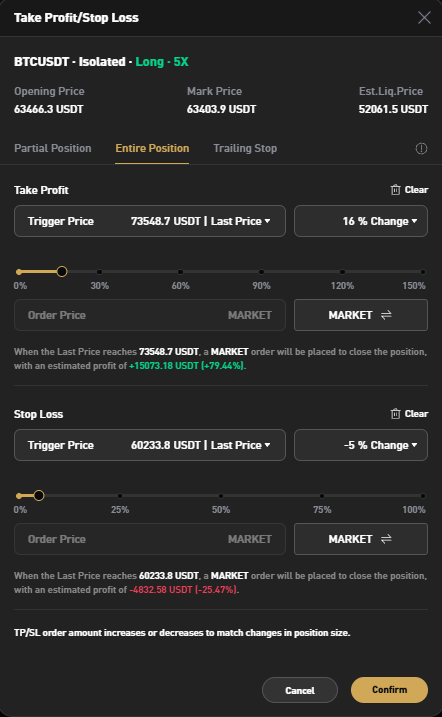
Partial TP/SL — part of the position, several levels. Technically this is the ladder itself.
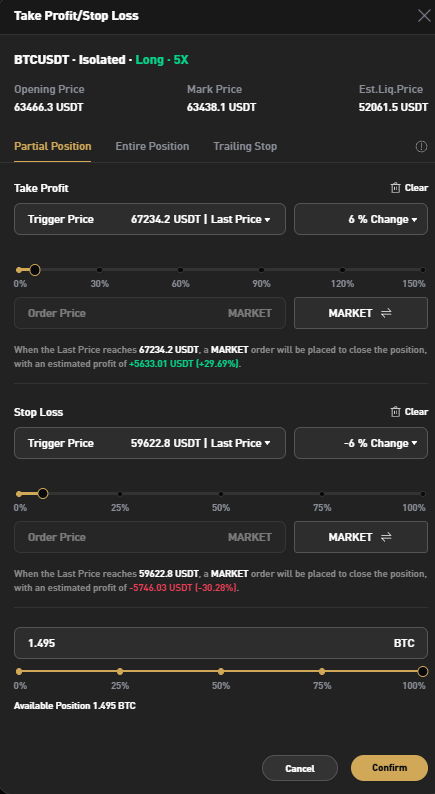
The tool works; the question is what you would use it for.
Then why three targets in the signal
The three levels in the message are a map of the trade, not an exit plan. They show the geometry: where breakeven sits, where the target is, how far price could travel.
Of the three, TP2 is the tested one. That is what goes into the terminal. The other two are arithmetically honest, but we have not measured their returns.
The journal and the daily circuit breaker
Two routine habits worth more than any strategy.
The journal is filled in BEFORE the entry
A journal filled in after the trade closes is useless. You already know the outcome and you fit the explanation to it.
Six lines before entry: date and coin; side; entry, stop and target as numbers; risk in percent and in money; fees as a share of risk; whether it agrees with the higher trend; and one sentence on why you are entering.
After it closes, two more: the outcome, and whether you followed your own plan. Any spreadsheet will do; no paid service required.
What to look for after a hundred trades
Not profit. The ratio of trades taken by plan to trades taken «because I felt like it».
If the second kind is more than a quarter, the problem is not the strategy. Changing strategy at that point is treating the wrong thing.
The daily circuit breaker
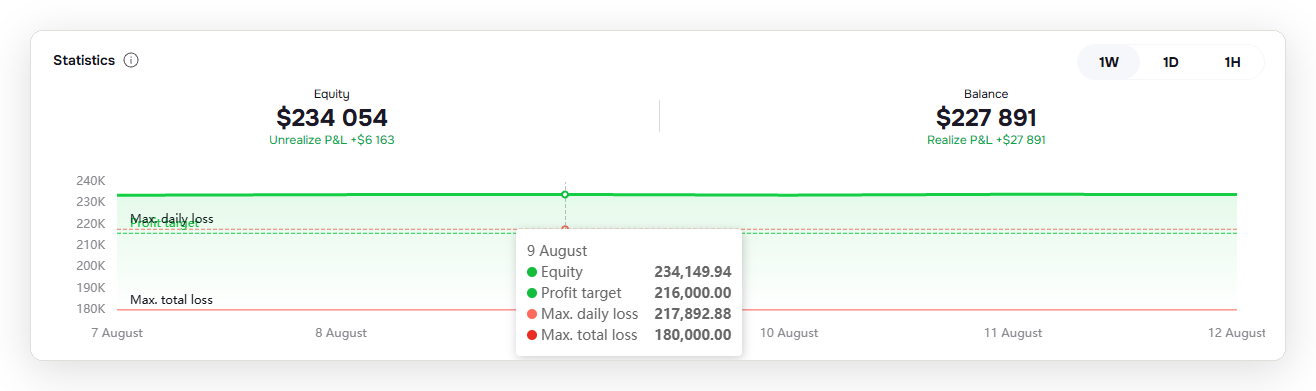
Name in advance the amount after which you close the terminal until tomorrow. The working figure is 3% of the account.
| No breaker | With breaker | |
|---|---|---|
| Stages passed | 51.0% | 56.7% |
| Blown on the daily limit | 11.5% | 0.0% |
Daily-limit blowups disappear entirely. The breaker fires roughly once every eighteen days.
The detail without which it does not work
Count it on equity: realised loss plus the sum of the stops on every open position.
Count only closed trades and, having shut down at three percent, three open positions will comfortably carry you to five.
On winning it back
The most expensive hour in trading is the one right after a large loss.
That is when position size starts being eyeballed, the stop starts being set «later», and the higher trend starts looking like an optional formality.
The breaker is not there to protect you from the market. It is there to protect you from that hour.
That is all the rules
One thing remains: applying them consistently. Signals arrive six times a day with the entry, stop and targets already calculated.
How to use the signals
The fields of the message are covered in module 04. Here is how it works day to day.
The schedule
The bot reads the market on closed four-hour candles — six times a day, three minutes after each close. Between those moments there is no reason to look at your phone; nothing new will appear.
The signal is calculated from the candle’s closing price. By the time you read the message the market has already moved. If price has travelled far from the entry, skip the trade. Do not chase.
When several signals arrive at once
This is normal. On one run the bot produced nine signals at once — seven longs and two shorts.
Not because it was a special day. Crypto moves in formation, and the same setup forms on a dozen coins at the same time.
The rule from module 07 applies without exception: take no more than three, and no more than 3% risk in total. The rest go by.
Which three matters less than it seems. We tested picking coins by past performance three times, and all three times it did not work. Take the first on the list, or the most liquid.
The bot can flip on a coin
Worth knowing in advance. The bot has no memory of your positions. Every four hours it looks at the market fresh. A short on a coin today; a long on the same coin the day after.
If the old position is still open, do not open the opposite one. The old one closes at its stop or target first; only then does a new signal on that coin come into play.
Two opposing positions on the same instrument cancel each other out and leave you with nothing but double the fees.
What the bot does not do
It does not know the size of your account. The numbers on the Size, Margin and Risk lines are computed from a nominal $10,000 deposit. Recalculate for your own using the formula from module 05.
It does not know what you already have open or how much you have lost today. Tracking exposure is on you.
And it does not see the whole picture. The decision to enter stays with you, with that distinction from module 04: skipping by a rule is fine, skipping by mood is not.
A signal is not advice
The bot’s message is the output of an algorithm run on historical patterns, not a recommendation to buy or sell. The decisions, and their consequences, are yours.
Common fears
I am afraid of losing money
That is the right fear. It does not need curing, it needs a number.
At 1% risk you know in advance the exact amount you lose if you are wrong. On a $10,000 account that is $100. Fear of a specific hundred is easier to carry than fear of the unknown.
If the amount still frightens you, it is too large for you right now. That is a legitimate answer, not a weakness.
Five losses in a row — is the strategy broken?
No. At a 35% win rate, five losses in a row happen roughly every ten trades. Ten in a row is rare, but still an ordinary event.
A strategy is judged over a hundred trades. Over five, only your patience is being judged.
There is something worth checking right now, though: whether you followed your own rules in all five. That is usually where the answer is.
I wait for the perfect setup and take nothing
Perfect setups do not exist. There are trades that fit the rules, and everything else.
Waiting looks like caution but is usually fear of being wrong. And an edge only exists across a long series: skip half the trades on instinct and you are left without the series.
I got stopped out and then price went my way
This will happen regularly. It is neither a mistake nor a conspiracy.
The stop sits where the coin’s noise ends, with room to spare. Sometimes the market reaches it anyway. The alternative — a wider stop and a smaller position — is already built into the calculation.
What you must not do: remove the stop, or move it away as price approaches.
How much time does this take per day
Trading four-hour candles, a few minutes to check and to open.
If it takes you an hour or more, you are watching open positions. That is not work, it is anxiety, and it ends in closing early.
The challenge: honest odds
Few people pass a challenge, and the reason is almost never that they called direction wrong.
There are three reasons, and all three are arithmetic, not talent:
- A position three times too large, because size came from the slider instead of the formula
- The stop was not placed before the entry
- Nine trades in an evening instead of three
The daily limit is breached in one evening, not over a month of bad luck. Everything that leads there is covered in modules 05, 07 and 09 — you already know all three mistakes and how not to make them.
That is not a guarantee. It is the difference between an attempt made blind and an attempt made by the rules.
What win rate you actually need
| Ratio | Breakeven | To actually earn |
|---|---|---|
| 1:1 | 50% | about 55% |
| 1:2 | 33% | about 38% |
| 1:3 | 25% | about 30% |
A 30% win rate at 1:3 beats 60% at 1:1. On its own a win rate means nothing — as module 10 showed, seventy percent can be drawn out of a coin flip.
What passing requires
| Stage 1 | Stage 2 | Trader | |
|---|---|---|---|
| Profit target | 8% | 6% | none |
| Daily limit | 5% | 5% | 5% |
| Total drawdown | 10% | 8% | 8% |
| Your profit share | — | — | 80% |
Minimum five trading days per stage. Leverage up to 1:5.
And most importantly: there is no time limit on any stage.
Which leads to something people constantly miss. Nothing here creates urgency except you. All overtrading on a challenge is self-inflicted.
What is on the other side
At the Trader stage the profit target disappears entirely; only the risk limits remain. Your share is 80% of profit: of every thousand earned on the firm’s account, eight hundred are yours.
And the condition that changes how you prepare: you have as much time as you need. You are not racing a calendar, only your own discipline.
Twenty trades a month by the rules beats a hundred in a hurry.
The fee is the price of an attempt
The fee is not a deposit and not an investment. It is payment for an attempt, and it is also your maximum loss.
That is the one structural difference from your own deposit: the ceiling on losses is known before you start. On your own account there is no such boundary.
The question before buying
Am I prepared to treat this amount as tuition rather than as a bet?
If yes, you are in the frame where this works, and discipline decides the rest. If no, take path A from module 03 first; it is free.
If you decide to go ahead
Buying takes a few minutes.
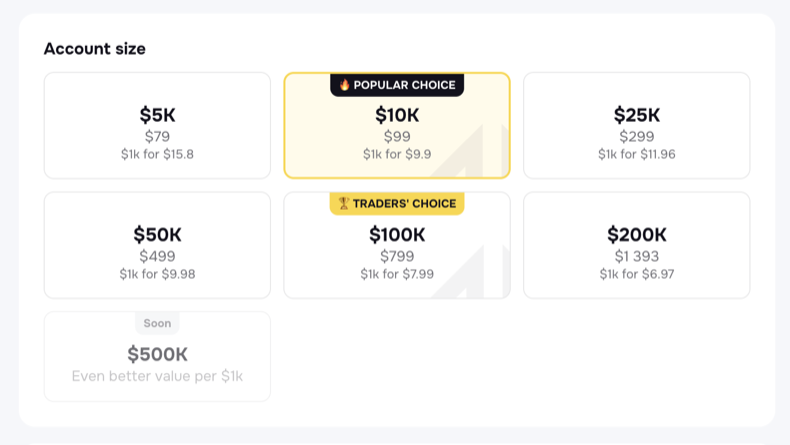
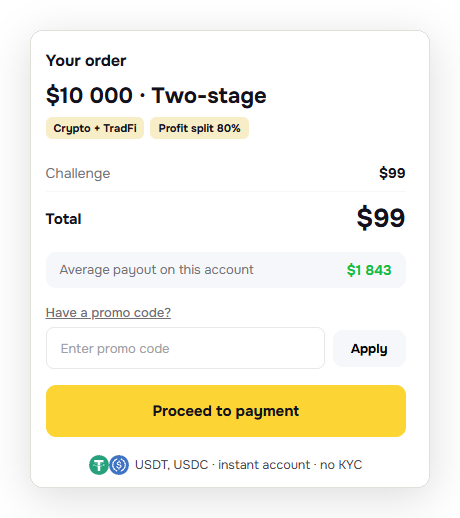
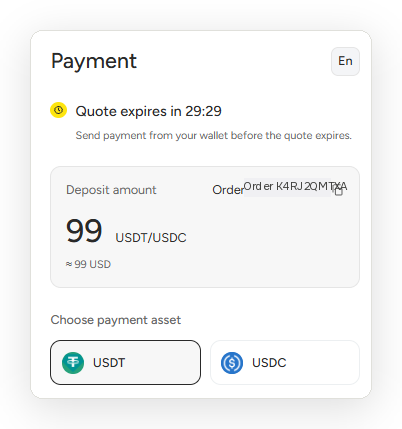
One thought on account size. The rules are identical across denominations, but the smaller the account, the cheaper the attempt. It makes sense to take a small first challenge: you are buying experience of working under someone else’s rules, not income.
Why there are no screenshots of my results
There is not a single screenshot of my profit on this page. That is deliberate.
Any result shown on the internet is a selected result. People show the good month, not all twelve. The good account, not all six. From the outside it cannot be verified, which means it carries no information.
My numbers would tell you nothing about yours anyway. Different account sizes, different discipline, different days of entry.
What is verifiable is the arithmetic. A 0.5% stop eats 12% of your risk: take a calculator and work it out. A five-target ladder produces a 70.9% win rate on random entries: build it in a backtester and see for yourself.
Every number on this page is built so that you can check it without me. That is the only kind of proof worth anything.
Why not «sometime later»
The bot recalculates the market six times a day, every four hours. While you were reading this page it worked through another bar.
The signals arrive whether or not you are ready. The only difference is whether you look at them or work from them.
A challenge has no time limit, but the hundred trades after which your statistics start to mean something will not accumulate by themselves. The sooner the series begins, the sooner you learn the truth about yourself.
Cheat sheet
Eight rules and the numbers behind them
Two minutes to read. Save it and open it before a trade.
Bet in the direction the market has already been going for two weeks.
Price above where it was 14 days ago: longs only. Below: shorts only. The only source of direction that survived nine years of history. The timeframe does not matter, the window length does.
Never risk more than 1% of the account on a single trade.
Size = risk amount ÷ distance to stop in percent. At 2% risk the chance of passing a stage drops to 30–47%.
No more than three trades at once, and count what you have already lost today.
A 3% risk ceiling, including the day’s loss. Counting what is already lost cuts daily-limit blowups from 18 to 6, and the result rises from $17,935 to $28,543.
Place the stop before entering and never move it against yourself.
Two ATR(14) from entry — anchored to the coin’s noise, not to a level on the chart. Results improve monotonically with stop width.
The tighter the stop, the more of your risk the exchange takes.
Round-trip fee ÷ stop size. Above 10%, the trade is not taken. With a 0.5% stop that is 12% of risk; with 8.7% it is just 0.7%.
Close the trade whole, at one point.
The entire position at 1:2, no partial exits and no move to breakeven. A five-target ladder cuts profit by more than half.
Down 3% on the day: close the terminal until tomorrow.
Count on equity, including the risk of open positions. Daily-limit blowups fall from 11.5% to zero.
Write down your reason for entering before the trade, not after.
Six lines. After a hundred trades, look not at profit but at the share of trades taken by plan.
What it takes to earn
At 1:1 you need 55% winning trades. At 1:2, 38%. At 1:3, 30%.
A 30% win rate at 1:3 beats 60% at 1:1. On its own, a win rate means nothing.
What we tested and discarded
Chart patterns · oscillators · picking coins by past results · scalping on 5- and 15-minute charts
The cheat sheet settles the question of what to do. What stays open is when — and that is what the signals are.
How much to take
Position size is not chosen, it is calculated. Enter your entry and stop; the rest follows the formula from module 05.
Long
$0
—
Targets
—
—
Calculating is half the job. The other half is knowing what to calculate.
Entry and stop arrive ready-made, six times a day.